

FIELD NOTE / BUILD
Browse verified AI-built project examples grouped by the job they solve, then inspect their tools, maturity and requested feedback.
SHORT ANSWER
The most useful vibe coding project examples are live products with a named user, problem, builder, stack, maturity and feedback request. Grouping them by the job they solve is more revealing than grouping them by visual style: it shows where AI-assisted development creates value and where product, security or operational work still remains.
Heyviber listed 11 public projects when this article was researched on August 8, 2026. Seven are live products published by Janne Ikola; four are clearly marked demonstration listings. This article uses the live set because each example has a working project page, an external app link, build-tool context and an explicit question for reviewers.
These listings are examples, not endorsements or security certifications. Start with non-sensitive data when trying an unfamiliar app, and read the broader vibe coding project evaluation guide before interpreting a polished interface as production evidence.
Which real vibe coding projects can you study?
The following screenshots are supplied through the public project listings and link back to the owner-controlled context. They show different problem categories rather than seven variations of the same landing page.

Peesi dashboard showing team challenges and employee advocacy scores
A Codex, Next.js and Prisma product that turns LinkedIn participation into challenges, points and team visibility.

Kehotesuunnittelija interface for building a structured reusable AI prompt
A Finnish React and Express service for building, saving and reusing prompts, multi-step Loops and AI skills.

ARVO-AI analysis view with customer review themes and prioritized actions
A Next.js product that turns Google Maps reviews into traceable themes, competitor comparisons and prioritized actions.

AI-Apuri workspace showing role-based AI workers and supervised business tasks
An alpha product for creating role-based AI workers, assigning repeatable tasks and monitoring results, cost and activity.
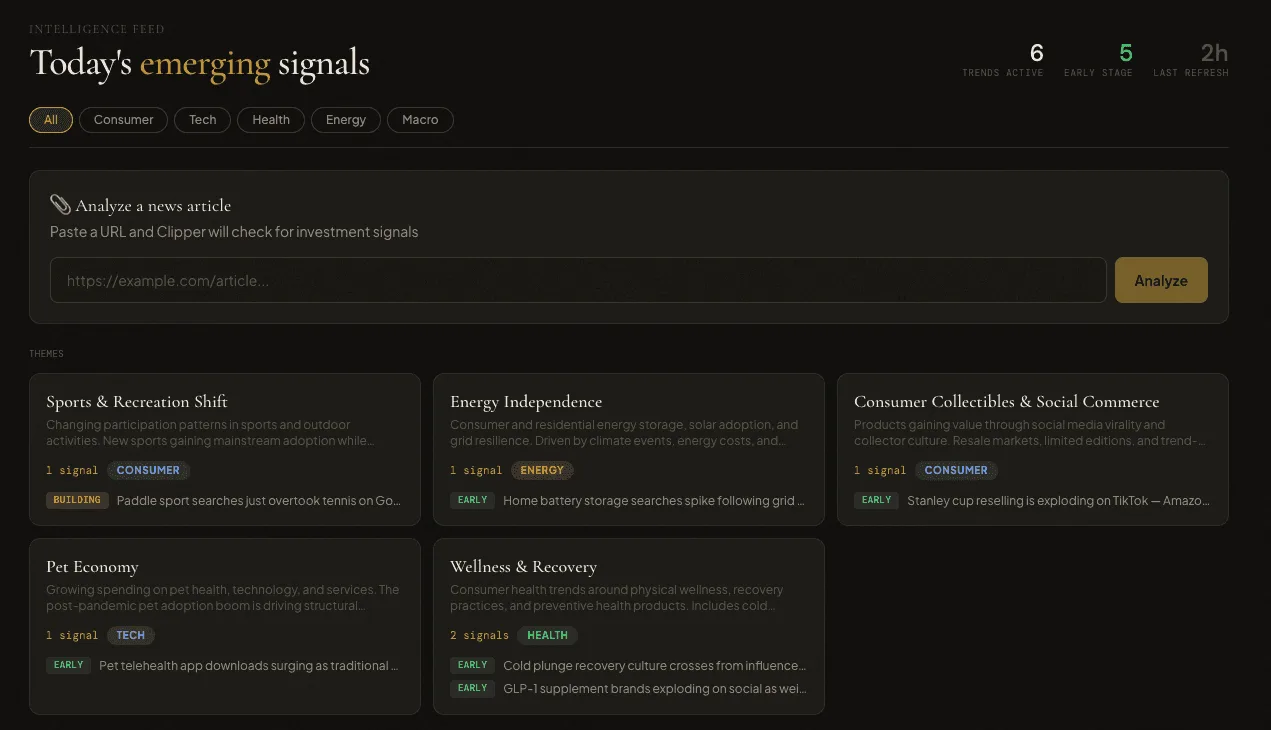
Stockclipper research dashboard showing consumer signals and evidence scores
A research workflow that scores consumer signals, economic materiality, negative evidence and later market follow-through.

Kohdevideo property-video preview created from real-estate listing photographs
An Express and Claude workflow that turns property images into a Finnish script, narration, subtitles and rendered video.
What problems do these AI-built apps solve?
The examples fall into four useful patterns.
Make a repeated workflow easier. Peesi packages recurring employee-advocacy activity into challenges and scoring. Kehotesuunnittelija makes prompt construction guided and reusable. Kohdevideo turns a multi-stage media-production task into a defined flow.
Interpret messy evidence. ARVO-AI works with customer-review data; Stockclipper works with consumer and market signals. In both cases, the product must make source context and uncertainty visible because the answer is not valuable if the user cannot inspect why it appeared.
Coordinate AI work under human control. AI-Apuri is not merely a chat screen. Its published scope includes roles, task delegation, budgets, logs and human review. That changes the main product question from “Can a model answer?” to “Can an owner understand and control what several workflows are doing?”
Help a person make a concrete decision. Mitä Ruuaksi?, another live listing in the directory, uses household meal memory to reduce the daily decision burden. The idea is simple; the product work lies in making capture light enough and resurfacing useful enough that the memory improves over time.
Which build tools appear in the examples?
The public listings name Codex as the main AI tool for the seven owner-published products. The surrounding stacks differ: Next.js, React, Express, Hono, Prisma, Drizzle, PostgreSQL, BullMQ, Clerk, Stripe, Claude and specialized market or media services appear across the set.
That variety is important. “Built with AI” does not identify the architecture, deployment model, database permissions, payment boundary or operating burden. The AI tool explains part of the development workflow. It does not replace the stack inventory a reviewer needs.
Problem category | Example | Build context to inspect | Best feedback question |
|---|---|---|---|
Participation workflow | Peesi | Scoring rules, LinkedIn data and team permissions | Does the first challenge feel fair and easy to start? |
Evidence analysis | ARVO-AI | Source traceability, competitor data and generated actions | Can the user see why the first action matters? |
Agent operations | AI-Apuri | Connectors, budgets, logs and human approval | Where does the user still lack control or trust? |
Research queue | Stockclipper | Independent sources, scoring and negative evidence | Which evidence changes a keep-or-reject decision? |
Media production | Kohdevideo.fi | Asset order, script control and render pipeline | Where should the owner edit before rendering again? |
What separates these examples from toy demos?
Each owner-published listing names a target user and a problem. It exposes a live app link and a request for feedback tied to the next product decision. Several also disclose maturity: AI-Apuri is described as an active alpha, for example. That context lets a reviewer calibrate expectations.
A toy demo can still teach a technical concept. The distinction matters when a page claims the project is a product. Product evidence includes an end-to-end job, ownership, persistent state where needed, meaningful failure handling, and a way to learn from users. Revenue and scale are not required, but the current stage should not be disguised.
Example-to-evidence ladder
Screenshot
Working core flow
Disclosed stack and maturity
Named user problem
Feedback and owner decision
Five-level ladder from screenshot and working flow through disclosed stack, real user context and owner learning loop
How should you browse project examples efficiently?
Choose a problem category first. Open the project page before the external app so you know what the owner claims, which tools are disclosed and what feedback is requested. Then complete one low-risk task and write down the exact point where the product became useful, confusing or untrustworthy.
Do not compare projects by feature count alone. A narrow app that solves one repeated task reliably may be more mature than a broad app with many generated screens. Compare the evidence required by the intended use: a creative prototype, internal workflow, public SaaS product and financial research tool carry different consequences.
Confirm that the listing distinguishes a live product from an example entry
Read the named user, problem, maturity and feedback request
Use non-sensitive inputs for the first end-to-end test
Inspect the disclosed stack without assuming it proves security
Leave one observation connected to the owner's requested decision
How we researched these project examples
We inspected the live Heyviber project directory and the individual project pages on August 8, 2026. We included only owner-published listings with external app links in the main gallery and kept the four seeded demonstration projects out of the live-project count. Categories are an editorial grouping based on the published problem, features and feedback request—not builder-supplied labels.
The screenshots come from URLs already published in the project listings. Image sources, appearance, and ownership can change, so readers should check the current listing. We did not claim independent security testing, traffic, revenue, customer adoption, or build-time results.
Where can you find more examples?
The Heyviber project directory is the live source. It can change after this article's research date, so use the directory count rather than treating this snapshot as permanent. Builders can publish a project with a clear maturity label, tool list and feedback question so a future gallery can compare genuine evidence instead of promotional claims.
Sources
NEXT STEP
See what other AI builders are shipping
Browse public projects, try the live apps, and leave a concrete improvement suggestion.